


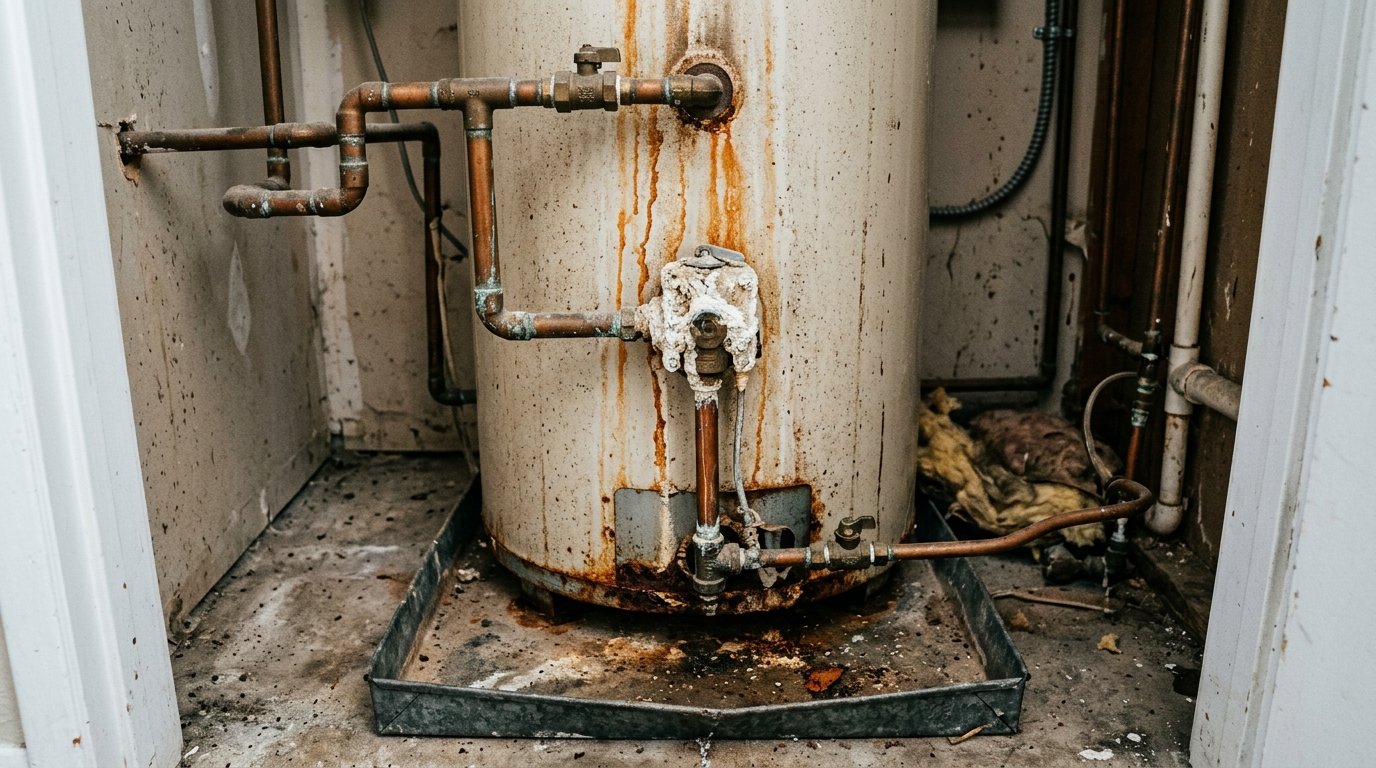
Short answer: In Northern Utah’s hard water, tank-style water heaters typically last 5–8 years — well below the 8–12 year national average. The cause: dissolved calcium and magnesium settle as sediment on the tank bottom, insulate the burner, and accelerate anode rod depletion. Annual flushes and a water softener can extend lifespan back toward the national average.
The national average lifespan for a tank-style water heater is 8 to 12 years. If you live in Northern Utah, you can expect to shave a few years off that number — and if you’ve never had your heater serviced, potentially more. We’ve been installing and replacing water heaters across Weber, Davis, and Cache counties for over a century, and the pattern is consistent: Utah’s exceptionally hard water is the single biggest factor that determines how long a water heater actually lasts.
How Hard Water Attacks Your Water Heater
When hard water enters your water heater, it carries dissolved calcium and magnesium in solution. Cold water can hold those minerals in suspension, but heated water cannot — when the temperature rises, the minerals precipitate out and settle as a solid deposit on the bottom of the tank and on the heating element. This process happens every single time the heater fires. Over months and years, the sediment layer builds up on the tank floor — sometimes an inch or more in heavily neglected units in high-hardness areas. That sediment layer acts as a thermal insulator between the burner and the water. Your heater is now working harder and burning more energy to heat water through a barrier that gets thicker every day. In Northern Utah, where water hardness commonly runs 15-25 grains per gallon, this process accelerates at a rate that homeowners from lower-hardness regions simply don’t encounter.
The Popping and Rumbling Sound — What It’s Telling You
If you’ve ever heard a water heater making a popping, rumbling, or cracking noise during the heating cycle, that’s sediment. The sound is water getting trapped under the sediment layer, superheating, and forcing its way through. It’s a sign the tank has already accumulated significant buildup and is operating under stress. Many homeowners ignore this noise for years, writing it off as normal. It isn’t. It’s the heater working at reduced efficiency, and it accelerates wear on the tank lining and the pressure relief valve. In a hard water area like Ogden, a water heater that has been rumbling for a year or two without being flushed has already lost a measurable percentage of its potential lifespan. By the time most homeowners call us about the noise, the sediment layer is substantial enough that a single flush won’t fully restore the unit.
The Anode Rod Problem in Hard Water Areas
Inside every tank-style water heater is a component most homeowners have never heard of: the anode rod. It’s a long metal rod — usually magnesium or aluminum — suspended inside the tank, and its entire job is to attract corrosion before that corrosion attacks the tank lining. It sacrifices itself so the tank doesn’t corrode. In areas with soft or average water, an anode rod might last four to six years before needing replacement. In Northern Utah’s hard water, we typically see anode rods fully depleted in two to three years. A fully depleted anode rod means there’s nothing left between the hard water chemistry and the steel tank lining. Corrosion accelerates, the tank develops pinholes, and what could have been a healthy unit is suddenly a replacement. We’re authorized dealers for Rheem, Bradford White, and AO Smith, and we’ve seen each brand’s performance in Utah water conditions — anode rod inspection and replacement is one of the simplest and highest-return maintenance steps you can do.
How Tankless Water Heaters Are Affected Differently
Tankless water heaters don’t accumulate sediment in a tank the way traditional units do, but they aren’t immune to hard water damage — it just shows up differently. The heat exchanger in a tankless unit is a dense coil of small-bore tubing where water passes quickly through intense heat. That geometry is extremely efficient, but it’s also extremely susceptible to scale buildup from hard water. As calcium deposits coat the interior walls of the heat exchanger, flow rate drops, efficiency falls, and in severe cases the exchanger can overheat or crack. Tankless manufacturers in hard water markets — Northern Utah is exactly this — recommend descaling the heat exchanger annually. We’ve seen units in Weber County that were installed without upstream water treatment fail in 4-5 years from scale damage to the exchanger. Pairing a tankless unit with a water softener is the standard recommendation we make for every tankless installation in this area.
How to Extend Your Water Heater’s Lifespan in Utah
The maintenance steps that matter most in a hard water market are straightforward. Annual flushing removes accumulated sediment before it builds into a thick insulating layer — it takes about 30 minutes and extends tank life meaningfully. Anode rod inspection and replacement every 3-4 years (or 2-3 years in particularly high-hardness homes) keeps the corrosion protection active. Temperature setting matters too — running the tank above 120°F accelerates both scale formation and anode consumption; 120°F is the standard recommendation for both safety and longevity. The single most effective long-term protection is installing a whole-home water softener upstream of the heater. Softened water dramatically reduces the mineral precipitation rate inside the tank, protects the anode rod from premature consumption, and can realistically extend a water heater’s service life by 3-5 years in Northern Utah conditions. We’ve seen the data in our own service history.
When to Repair vs. Replace
The decision to repair versus replace a water heater comes down to age, condition, and impact. A heater under 7 years old with a single component failure — a thermostat, a heating element, a pressure relief valve — is usually worth repairing. Once a tank-style unit is past 8-10 years in Northern Utah’s water conditions, particularly if it has never been serviced, the calculus shifts. Repair impacts on an aged unit don’t stop at one repair; you’re often chasing an end-of-life situation with multiple components approaching failure simultaneously. If the tank itself is corroding or the anode rod has been depleted for an extended period, no repair restores the tank. At that point, replacement with a properly sized, properly installed unit — and ideally a water softener if one isn’t already in place — is the better investment. We’ll give you an honest assessment either way.
Your water heater works hard in Northern Utah, and it needs more attention than it would in a soft-water city. If you haven’t had yours flushed or inspected in the last year or two, it’s worth a call. Mike Bachman Plumbing installs and services water heaters across Weber, Davis, and Cache counties, and as authorized Rheem, Bradford White, and AO Smith dealers, we can match the right equipment to your home’s specific water conditions. Call us at (801) 627-5953 to schedule a service visit — or to talk through whether repair, replacement, or a water softener is the right next step for your home.
About Mike Bachman Plumbing
Mike Bachman Plumbing has served Northern Utah since 1915 — six generations of the Bachman family solving plumbing problems across Weber, Davis, and Cache counties. We are fully licensed and insured in Utah, and every technician we send to your home is background-checked and drug-tested. Our work is backed by a 100% satisfaction guarantee, and we answer emergency calls 24 hours a day, 365 days a year.
Call (801) 627-5953 or visit our shop at 549 W 24th St, Ogden, UT 84401.