
Short answer: In Utah’s hard water, tankless water heaters can be worth it — but only paired with a water softener. Without softening, mineral buildup inside the heat exchanger destroys a tankless unit faster than it would destroy a traditional tank. Tankless gives you endless hot water and longer lifespan; traditional has lower upfront impact and simpler installation.
We install both tankless and traditional water heaters, so we don’t have a financial reason to push you one way or the other. But the question we hear constantly — especially from homeowners who’ve read one too many manufacturer brochures — is whether tankless is worth it in Utah. The honest answer: it depends, and the factor that changes everything is our water. Northern Utah’s exceptionally hard water affects both types of water heaters in ways that most buying guides ignore entirely. Here’s the practical breakdown for a Northern Utah home.
How Each Type Works
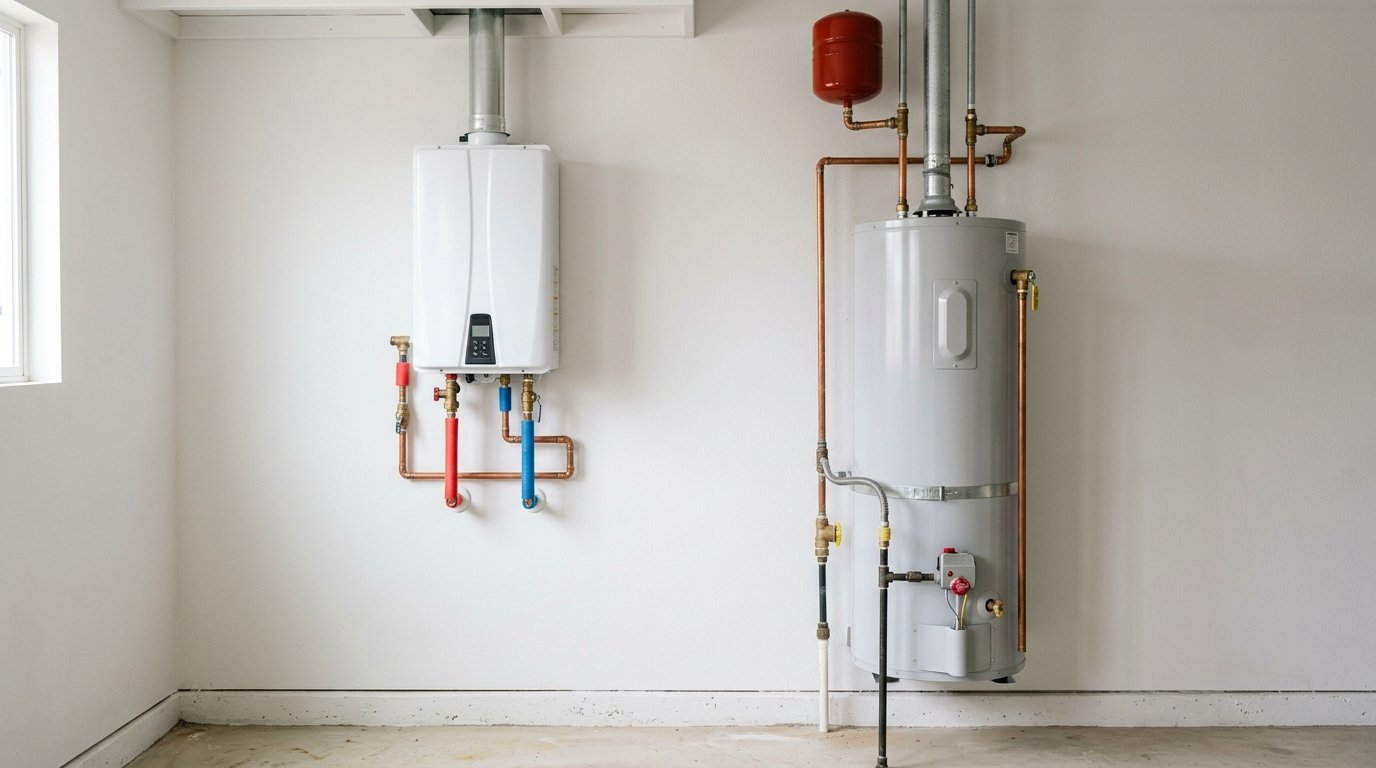
A **traditional tank water heater** stores 40–80 gallons of water in an insulated tank, heating it continuously to maintain a set temperature. When you open a hot tap, pre-heated water flows immediately from the tank. The tradeoff: you’re paying to keep that water hot 24 hours a day, and when the tank empties, you wait for it to reheat.
A **tankless (on-demand) water heater** has no storage tank. When you open a hot tap, cold water flows through a heat exchanger — either a gas burner or electric heating element — and exits hot. As long as demand doesn’t exceed the unit’s flow rate capacity, hot water is continuous. There’s no waiting for a tank to recover, and no energy spent maintaining a reserve of heated water when no one’s home.
Both types work. The question is which works better for your specific home, usage patterns, and — critically in Northern Utah — your water quality.
The Utah Hard Water Factor
This is where most buying guides go wrong. They compare tankless vs. tank in a vacuum, without accounting for what the water is actually doing inside those units.
Ogden municipal water and well water throughout Weber, Davis, and Cache counties consistently measure in the ‘very hard’ range — typically 200–400+ mg/L of calcium and magnesium carbonate. That mineral load affects both water heater types, but differently.
**In a traditional tank heater**, minerals settle as sediment at the bottom of the tank. Over time, that sediment layer insulates the burner from the water, reducing efficiency and causing the unit to run longer and hotter to maintain temperature. You’ll often hear a popping or rumbling sound from a tank that needs to be flushed — that’s steam bubbling through sediment. In Utah, tank heaters that are never maintained often fail 3–5 years ahead of their rated lifespan.
**In a tankless water heater**, minerals deposit inside the heat exchanger — a compact, expensive component with narrow water channels. Scale buildup in a heat exchanger reduces flow, causes pressure drops, and eventually leads to component failure. Without a water softener, a tankless unit in Ogden can develop significant scale issues within 2–3 years. The heat exchanger repair or replacement is not low-quality.
**The bottom line on hard water:** both types need maintenance in Utah. The difference is that tankless units are more sensitive to hard water and the consequences of neglect are more severe and more expensive.
Honest Pros and Cons for a Northern Utah Home
The Critical Pairing: Tankless + Water Softener
If there’s one thing we’d tell every Northern Utah homeowner considering tankless: a water softener is not optional — it’s part of the system.
A tankless water heater installed without a softener in Ogden’s hard water is a short-lived investment. The manufacturers know this; read the fine print in most tankless warranties and you’ll find language about water quality requirements. We’ve replaced heat exchangers in units that were only a few years old because the homeowner was sold a tankless system without being told about the water treatment requirement.
The combination of a tankless water heater plus a whole-home water softener is genuinely excellent for a Northern Utah home. You get the performance benefits of on-demand hot water, and the softener protects the heat exchanger while also extending the life of every other appliance in your home — dishwasher, washing machine, faucets, shower heads. The softener pays for itself multiple times over.
If a water softener isn’t in the budget right now, a traditional tank water heater with an annual flush and anode rod inspection is a more appropriate choice. It’s honest advice, and it’s the kind we’ve always given.
Gas vs. Electric, Sizing, and What Brands We Install
**Gas vs. electric in Utah:** Gas tankless units are significantly more capable in our climate. Because Northern Utah winters can push incoming water temperatures down to 38–42°F, you need the BTU output that only gas provides to deliver an adequate temperature rise across adequate flow rates. Electric tankless units can work in moderate climates, but in a Utah winter they often require expensive electrical upgrades and still struggle with whole-home demand.
**Sizing matters more in cold climates.** A tankless unit that’s adequate in Phoenix may be undersized in Ogden. We size every installation based on the number of simultaneous hot water uses and our winter ground-water temperature data. An undersized unit is one of the most common mistakes we see in tankless installations done without local knowledge.
**When tankless clearly makes sense:** larger families in homes with existing gas lines, homeowners already planning to install a water softener, anyone staying in the home long-term who wants lower operating impacts, and anyone who’s tired of cold showers.
**When a traditional tank makes more sense:** smaller households, homes on tight upfront budgets, homes without natural gas, and anyone who prefers lower-maintenance simplicity.
**Brands we install:** We work with Rheem, Bradford White, and A.O. Smith — all manufacturers with strong warranty support, readily available parts, and a track record we trust. We don’t install brands that look impressive in a brochure but leave us unable to source parts two years later.
There’s no universally right answer between tankless and traditional — but there are wrong answers, and in Northern Utah, the biggest one is ignoring what hard water does to your equipment. Call Mike Bachman Plumbing at (801) 627-5953 to talk through your specific situation. We’ll tell you what actually makes sense for your home, your budget, and your water. Six generations, over a century in the business, and we’ve never made money recommending equipment that wasn’t right for the job.
About Mike Bachman Plumbing
Mike Bachman Plumbing has served Northern Utah since 1915 — six generations of the Bachman family solving plumbing problems across Weber, Davis, and Cache counties. We are fully licensed and insured in Utah, and every technician we send to your home is background-checked and drug-tested. Our work is backed by a 100% satisfaction guarantee, and we answer emergency calls 24 hours a day, 365 days a year.
Call (801) 627-5953 or visit our shop at 549 W 24th St, Ogden, UT 84401.