
Short answer: Sewer line warning signs: slow drains in multiple fixtures, gurgling toilets, sewer smell in the yard, patches of unusually green grass, soft spots in the lawn, and recurring backups. In Northern Utah homes built before 1970, original clay or cast iron sewer lines are reaching end-of-life. A camera inspection is the right diagnostic first step.
If your Ogden home was built before 1970, there’s a good chance your sewer line is made of clay tile or cast iron — original materials that have been in the ground for 50 to 100 years. We’ve been working in these neighborhoods since before most of those pipes were laid, and we’ll tell you honestly: aging sewer infrastructure is one of the most pressing plumbing concerns for homeowners across Weber, Davis, and Cache counties. Knowing the warning signs can be the difference between a camera inspection and a camera inspection plus full excavation.
7 Warning Signs Your Sewer Line Is Failing
These symptoms often appear gradually. Don’t dismiss any of them as a minor inconvenience.
**1. Multiple drains slow at once.** A single slow drain is usually a localized clog. When two or more drains throughout the house — toilets, tubs, kitchen sink — are all draining slowly at the same time, the problem is almost always in the main sewer line, not an individual fixture.
**2. Sewage smell in your yard or basement.** Sewer gas has a distinct, unmistakable odor. If you’re catching it near a floor drain, in a crawl space, or outside near your yard, there’s an open breach somewhere in the system.
**3. Gurgling sounds from drains or toilets.** When you flush a toilet and hear gurgling from a nearby tub, or run the sink and hear sounds from the floor drain, that’s air being pushed through a partially blocked or vented sewer line.
**4. Sewage backup in the lowest fixtures.** Floor drains in the basement or first-floor toilets are the first to back up when the main line is blocked. If sewage is coming up through a floor drain, the line is either fully blocked or has collapsed.
**5. Soggy or sunken patches in the yard.** A leaking sewer line saturates the surrounding soil. You might notice patches of unusually green or lush grass, or soft, wet areas of lawn that don’t dry out.
**6. An unusually green strip of grass.** A linear patch of especially lush, dark green grass following the path of your sewer line is a classic sign of a slow leak feeding the soil above.
**7. Cracks in the foundation.** In severe cases, a leaking sewer line erodes the soil beneath a foundation. This is a worst-case scenario, but it happens — and it always starts with warning signs that were ignored.
Why Northern Utah Is Particularly Vulnerable
Ogden and the surrounding communities have a specific combination of factors that accelerate sewer line deterioration.
**Age of the housing stock.** Much of Ogden’s established residential neighborhoods — near downtown, Ogden Bench, South Ogden, and into Layton — were built between 1910 and 1960. The sewer infrastructure installed during that era used clay tile pipe, which is porous, prone to cracking, and has joints that shift over time. Many of these lines have had no maintenance in decades.
**Tree root intrusion.** Northern Utah neighborhoods are lined with mature cottonwoods, maples, and elms — beautiful trees whose root systems actively seek water. Clay pipe joints are a perfect entry point. Once roots establish inside a line, they grow and expand with every season. Tree root intrusion is the single most common cause of sewer line failure we see in Ogden-area homes.
**Freeze-thaw cycles.** Utah winters put tremendous stress on underground pipes. Ground movement from repeated freezing and thawing opens cracks in already brittle clay pipe and shifts pipe joints that were once watertight.
**Soil conditions.** The clay-heavy soils common in the Great Salt Lake basin expand when wet and contract when dry, creating constant movement around buried pipes. Over decades, this shifts and separates pipe sections.
Why Camera Inspection Is Always the Right First Step
If you’re experiencing any of the warning signs above, the worst thing you can do is authorize excavation before you know what you’re dealing with. We’ve seen homeowners pay other companies to dig up their yard looking for a problem that turned out to be a localized root intrusion 15 feet from where they were digging.
A sewer camera inspection impacts a fraction of excavation and gives us complete information before any decisions are made. We run a flexible camera through your main line from a cleanout or through a pulled toilet, and we can see exactly:
– Where blockages or root intrusions are located
– The condition of the pipe (cracks, offsets, full collapses)
– The type of pipe material currently in the ground
– Whether the problem requires cleaning, spot repair, or full replacement
With 111 years of experience in Northern Utah’s soil conditions and housing stock, we can look at camera footage and tell you honestly whether your line has years of life left or whether you’re dealing with something that needs to be addressed now. We don’t upsell repairs that aren’t needed.
Hydro-Jetting vs. Snaking: What Actually Solves the Problem
When roots, grease, or debris are blocking a sewer line, there are two main clearing methods — and they’re not equal.
**Drain snaking** (also called mechanical rodding) uses a rotating cable with a cutting head to break through blockages. It’s effective for soft clogs and can cut through roots. The limitation: it punches a hole through the obstruction without removing it. Roots that are snaked typically grow back within 6–12 months.
**Hydro-jetting** uses high-pressure water (up to 4,000 PSI) to blast a line clean. It removes root debris, grease buildup, and mineral scale — not just piercing the clog, but cleaning the pipe walls thoroughly. For older lines with significant root intrusion or grease accumulation, hydro-jetting provides a much more complete solution.
The right choice depends on the camera findings. For a simple soft clog, snaking is sufficient. For a heavily root-infiltrated line in a 70-year-old neighborhood, hydro-jetting followed by a post-cleaning inspection gives you the full picture of what you’re working with.
Repair vs. Replacement: Making an Informed Decision
Not every sewer line problem requires full replacement. We help homeowners make the decision that actually makes sense for their situation.
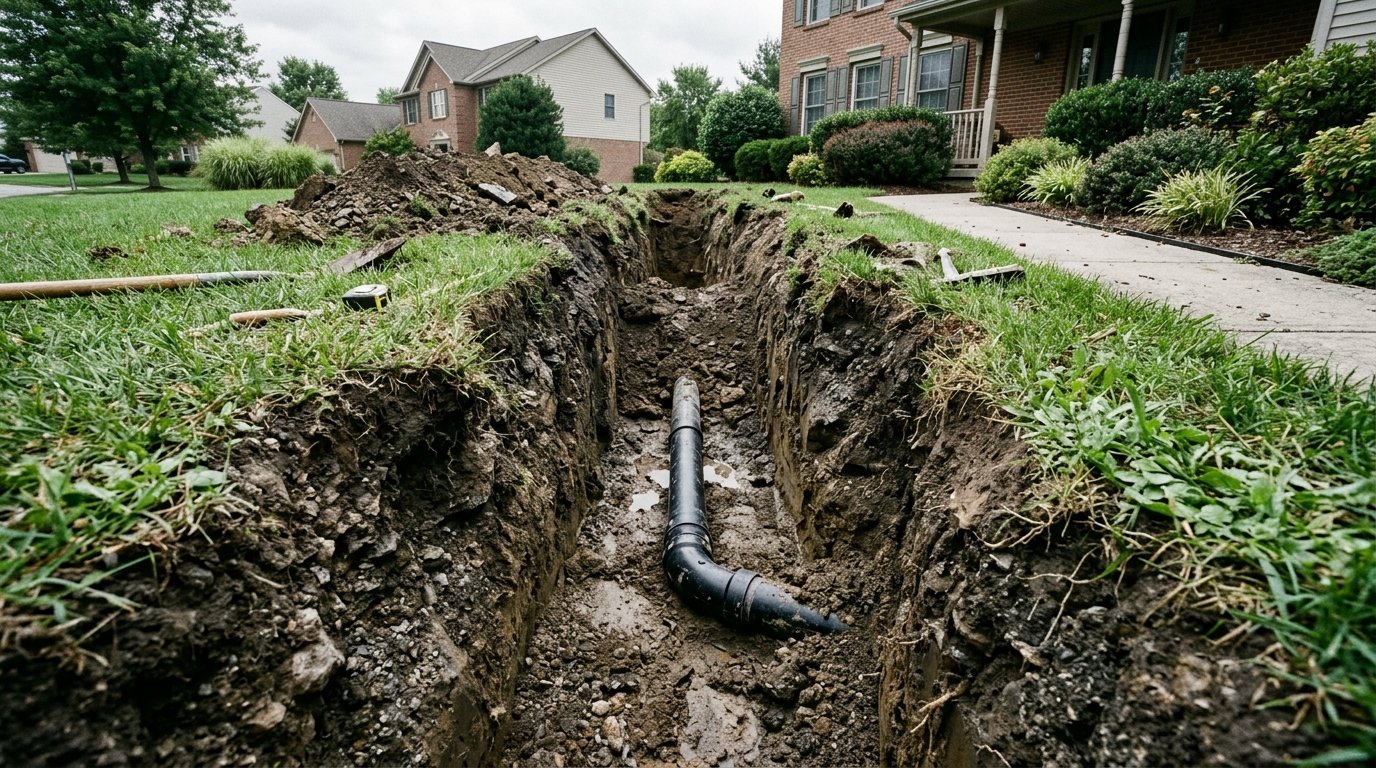
**Spot repair** is appropriate when a specific section of pipe has a crack, offset joint, or isolated root intrusion, but the rest of the line is in acceptable condition. We excavate and replace only the affected section.
**Full replacement** is the right call when camera inspection reveals widespread deterioration — a line that’s extensively cracked, has multiple offset joints, or has collapsed sections in several places. Doing a spot repair on a line that’s failing throughout just delays the inevitable.
**Pipe lining (trenchless repair)** is an option in some cases — an epoxy liner is cured inside the existing pipe, creating a new smooth surface without excavation. It works well on certain pipe conditions and can extend line life significantly.
We’ve seen every type of sewer failure across every Ogden-area neighborhood over the past century. When we give you a recommendation, it’s based on what’s actually in the ground — not what generates the largest invoice.
If you’re seeing any of these warning signs, don’t wait for a full backup to force your hand. Call Mike Bachman Plumbing at (801) 627-5953 for a camera inspection. We serve Ogden, Layton, Roy, Clearfield, and all of Northern Utah 24/7. Six generations of our family have been working in these neighborhoods — we know the soil, the pipe vintages, and the right fix for every situation.
Related: drain cleaning.
About Mike Bachman Plumbing
Mike Bachman Plumbing has served Northern Utah since 1915 — six generations of the Bachman family solving plumbing problems across Weber, Davis, and Cache counties. We are fully licensed and insured in Utah, and every technician we send to your home is background-checked and drug-tested. Our work is backed by a 100% satisfaction guarantee, and we answer emergency calls 24 hours a day, 365 days a year.
Call (801) 627-5953 or visit our shop at 549 W 24th St, Ogden, UT 84401.