
Short answer: Signs your Ogden home needs repiping: rust-colored water, dropping water pressure across multiple fixtures, frequent pinhole leaks, visible corrosion on exposed pipes, and any home built before 1970 with original galvanized steel still in the walls. Repiping in copper or PEX typically impacts less long-term than chasing patch repairs.
If your Ogden home was built before 1970, there’s a reasonable chance the original water supply pipes are still in the walls. Galvanized steel pipes were the standard from the early 1900s through the 1960s, and while they were built to last, they weren’t built to last forever. When galvanized pipe reaches the end of its service life — and in many homes in Central Ogden, the Bench neighborhoods, and along the Jefferson Avenue corridor, it already has — no amount of patching repairs the underlying problem.
A Quick History of Ogden’s Housing Stock and Its Plumbing
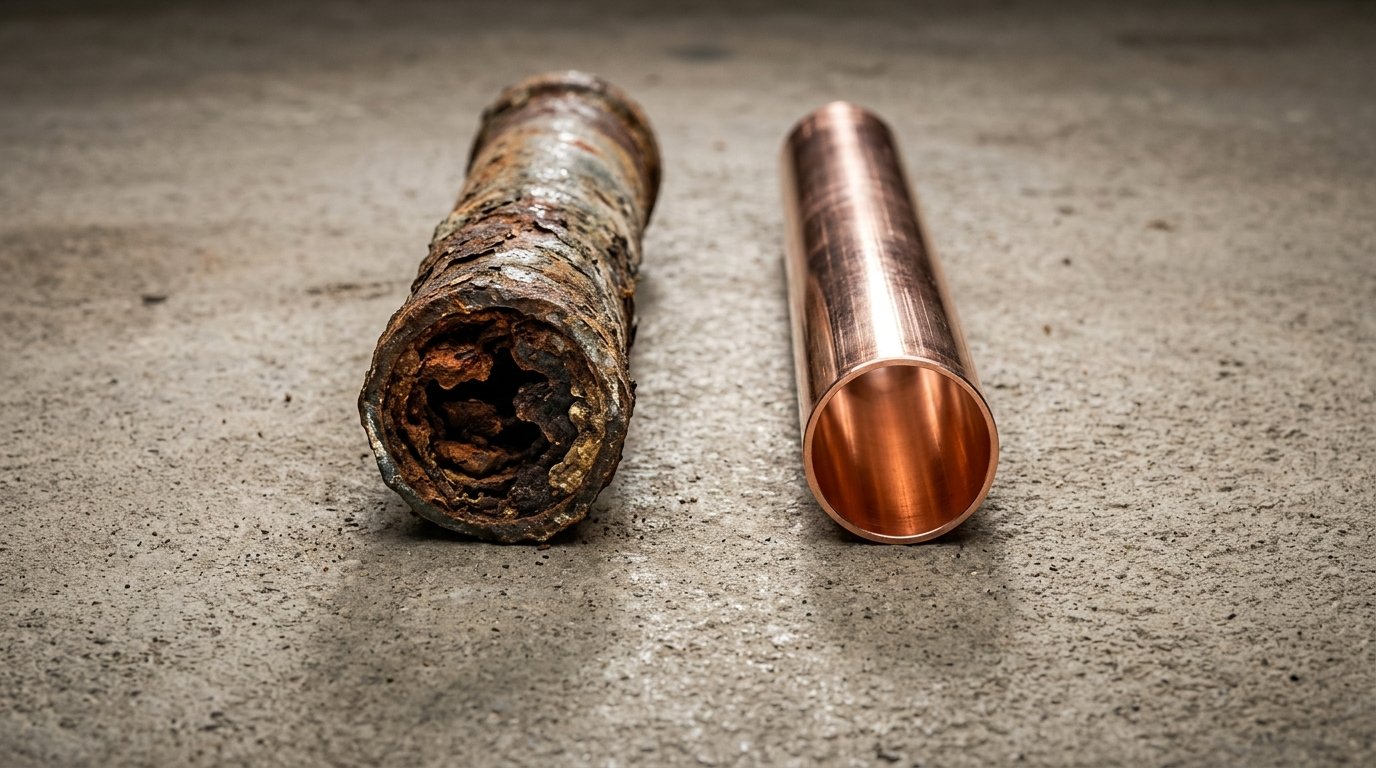
Ogden was an established city long before most western metros existed. The housing stock reflects that history: a significant percentage of homes in the established neighborhoods were built between the 1900s and 1950s, during an era when galvanized steel pipe was the universal standard for residential water supply lines. Galvanized pipe is carbon steel coated in a layer of zinc to resist corrosion. That zinc layer works for 40-70 years depending on water chemistry — and then it doesn’t. Once the zinc coating wears through, the pipe starts corroding from the inside out. Unlike copper or PEX, which fail at joints or from external damage, galvanized deteriorates all along its length simultaneously. Over 111 years of plumbing work in Ogden, we’ve seen every era’s pipe vintage, and we know exactly which neighborhoods and construction periods produce the most calls. If your home is from the 1940s or 1950s and hasn’t been repiped, the clock is likely running out.
How to Tell If You Have Galvanized Pipes
Before you can know whether repiping is relevant to you, you need to know what your pipes are made of. The easiest way is to find an exposed section — usually in the basement, utility room, or under a sink — and scratch it lightly with a coin or key. Galvanized steel will show a dull silvery-gray color when scratched. Copper will reveal a distinct orange or reddish tone. PVC or CPVC plastic pipes are self-evident. If you have galvanized, check the age of the home and whether any repiping records exist in the permit history — the city of Ogden keeps permit records that can confirm prior work. If you’re buying or selling an older home, a plumbing inspection that includes a visual assessment of the pipe material is worth the money.
The 5 Signs Your Galvanized Pipes Are Failing
These are the patterns we see repeatedly in homes whose galvanized pipes have reached the end of their service life. First: rust-colored or brown water, especially when you first turn on a tap after the water has been sitting. This is oxidized pipe material breaking free and entering your water stream. Second: low water pressure that has developed gradually over years. As pipes corrode internally, the passage narrows — sometimes to less than half its original diameter in severe cases. Third: discolored water only from the hot side. Because hot water accelerates corrosion, the hot supply lines typically fail before cold lines in the same home. Fourth: recurring small leaks at joints, patch repairs that hold for a year or two then leak again nearby. Once corrosion is active, it moves along the pipe. Fixing one spot doesn’t stop the process. Fifth: visible rust staining around any fitting or connection point where even minor seepage is oxidizing the outside of the pipe.
What the Repiping Process Actually Involves
Whole-home repiping sounds more disruptive than it typically turns out to be. We replace your existing supply lines with either PEX or copper — PEX is our most common choice for older homes because it’s flexible enough to route through existing wall cavities with smaller access points, it handles hard water well, and it has a long service life. The work typically takes one to three days for a standard single-family home, depending on size and complexity. You’ll have the water shut off during working hours but restored each evening so the house remains livable. We pull the necessary permits through the city of Ogden, which means the work is inspected and documented — important for resale value and insurance. Most homeowners don’t need to leave during the work, though having somewhere to be during the active work hours makes it easier. After we’re finished, you’ll have new pipes throughout the home, documented with permits, and a clear baseline for the next several decades.
Repiping vs. Endless Patch Repairs: The Real Math
We understand why homeowners hesitate at the impact of a full repipe. But consider the alternative math. A patch repair on a failed joint impacts a few hundred dollars and buys you some time. If the underlying corrosion continues — and it will — you’ll repeat that repair at another point in 12 to 18 months. Over five years, those repair calls add up fast, and none of them solve the actual problem. Meanwhile, a pinhole leak inside a wall that goes unnoticed for a few weeks can produce mold remediation impacts that dwarf the repipe. We’ve done the full repiping calculation with hundreds of Ogden homeowners over the years, and in homes with galvanized pipe past 50 years old, repiping almost always wins financially within 3-4 years when you factor in the repair frequency and the water damage risk. The decision point is usually when you’re on your second or third repair in the same general area of the house.
If your Ogden home is showing any of these signs — or if you simply don’t know what your pipes are made of — a plumbing inspection is the right starting point. We’ve been repiping homes in Weber and Davis counties for generations and know the specific pipe vintages and failure patterns in every era of Ogden construction. Call Mike Bachman Plumbing at (801) 627-5953 to schedule an assessment, and we’ll give you an honest picture of what your pipes look like and what your options are.
Related: leak repair.
About Mike Bachman Plumbing
Mike Bachman Plumbing has served Northern Utah since 1915 — six generations of the Bachman family solving plumbing problems across Weber, Davis, and Cache counties. We are fully licensed and insured in Utah, and every technician we send to your home is background-checked and drug-tested. Our work is backed by a 100% satisfaction guarantee, and we answer emergency calls 24 hours a day, 365 days a year.
Call (801) 627-5953 or visit our shop at 549 W 24th St, Ogden, UT 84401.