
Short answer: During a plumbing emergency: (1) shut off the water at the main valve, (2) shut off power to the affected area if water is near electrical, (3) call a 24/7 plumber, (4) document damage with photos for insurance, (5) move valuables out of the water path. Knowing where your main shutoff is before an emergency is the single best preparation.
A plumbing emergency doesn’t care what time it is. At 2 a.m. on a Tuesday in January, when a pipe bursts and water is running across your basement floor, panic is the natural response — but it’s not useful. Here’s exactly what to do, step by step, so you can limit the damage while help is on the way.
Step 1: Shut Off the Water — Right Now
This is the only thing that matters in the first 60 seconds. Every second water is flowing into your home is more damage. Here’s where to find the shutoff:
**For a localized problem** (leaking toilet, burst pipe under a sink, washing machine flooding): look for the shutoff valve on the supply line going directly to that fixture. On a toilet, it’s the oval knob on the wall behind and below the tank. Under a sink, it’s the small valve on the supply line inside the cabinet. Turn clockwise to close.
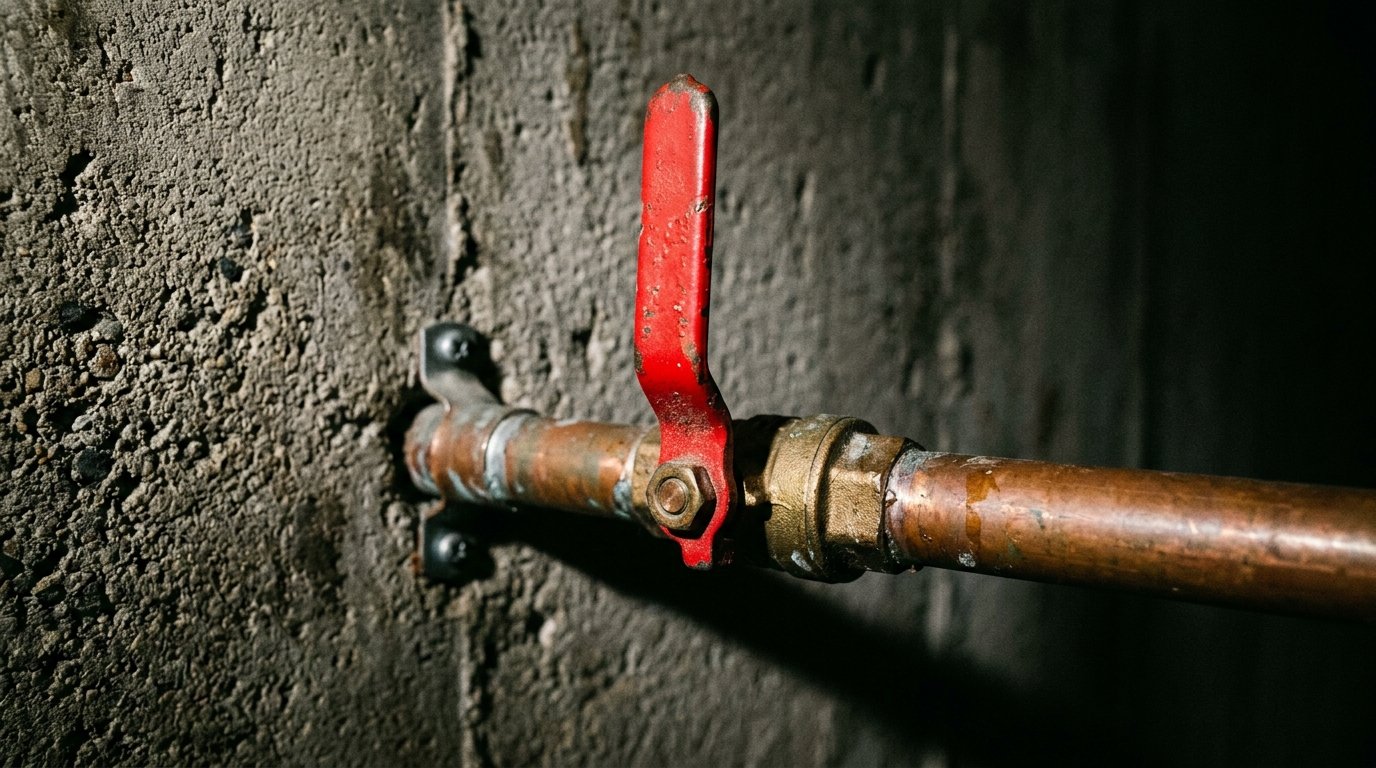
**For a burst pipe, major flooding, or any situation where you can’t find the fixture shutoff**: go to your main shutoff valve. In most Ogden and Northern Utah homes, this is one of three places: in the basement near where the water main enters the house (typically the north or east wall), in a utility room near the water heater, or in a crawl space access. It may be a round wheel valve or a straight-handle ball valve — turn the wheel clockwise, or turn the handle perpendicular to the pipe.
If you genuinely can’t find it, call (801) 627-5953 right now and we’ll walk you through it while we’re en route. We answer 24/7 — not an answering service, an actual person.
Step 2: Identify What You’re Actually Dealing With
Not all plumbing emergencies are the same, and your next move depends on the situation:
**Burst or broken pipe (flowing water, wet walls, ceiling):** Water off, stay out of flooded area, don’t touch electrical outlets or switches near the water. Take photos immediately for insurance.
**Overflowing toilet:** Lift the back tank lid and push down the rubber flapper to stop the flow. Turn the shutoff valve on the wall. Do not flush again.
**Sewage backup (water backing up into tubs, floor drains, toilets gurgling):** Stop using all water in the house immediately — every drain in your home connects to the same sewer line. Do not run dishwasher, washer, flush toilets, or run any faucet. Open windows if the smell is strong. This is a health hazard.
**Gas smell (different from sewage odor — sulfur/rotten egg):** This is not a plumbing call, it is a gas emergency. Get everyone out of the house, leave the door open, do not flip any switches, and call Questar/Dominion Energy and 911 from outside.
**Water heater failure (no hot water, water pooling around base, popping/rumbling sounds):** Turn off the cold water supply valve at the top of the heater. For a gas heater, turn the dial to PILOT. For electric, flip the breaker.
Step 3: Protect What You Can
Once the water is off and the situation is identified, you have a few minutes to reduce the damage before help arrives:
**Move valuables out of wet areas** — electronics, documents, anything on the floor. Water damage spreads fast on carpet and drywall.
**Document everything with photos and video** before you move anything or clean up. Your insurance company will want this. More documentation is always better.
**If there’s standing water near electrical outlets, panels, or appliances, do not enter that area.** Turn off the breaker for that zone at your electrical panel if you can safely reach it.
**Place buckets under active drips** you can’t stop with a shutoff valve. This sounds obvious, but people forget in the stress of the moment.
**If you shut off your main water supply**, turn off your water heater as well. A water heater that fires up with no water supply can damage the heating element — it’s called a dry fire, and it can ruin the unit. Gas heaters: turn to PILOT. Electric: flip the breaker.
The Most Common Northern Utah Plumbing Emergencies
We’ve been answering emergency calls in Ogden and Northern Utah for 111 years. These are the ones we see most often, especially seasonally:
**Frozen and burst pipes (January–February):** Northern Utah winters regularly push below zero, and pipes in exterior walls, crawl spaces, garages, and under mobile homes freeze. When water freezes, it expands and splits the pipe — the damage often doesn’t show up until the thaw. If you suspect a frozen pipe but it hasn’t burst yet, do not use a torch or open flame to thaw it. Use a hair dryer on low heat and call us.
**Sewage backup (year-round, worse in spring):** Tree root intrusion into sewer lines is extremely common in older Ogden neighborhoods. Spring rains saturate soil and accelerate root growth into any crack. Signs: multiple drains slow at once, gurgling sounds from toilets, odors from floor drains.
**Water heater failure:** Weber County’s hard water accelerates sediment buildup, which shortens water heater lifespan. When a water heater fails suddenly, it’s often because it was overdue for a flush and inspection.
**Running toilet overflow:** A faulty flapper valve or float causes the toilet to run continuously. When a toilet clogs while running, it overflows quickly. Know where your toilet shutoff valve is before you need it.
While You’re Waiting for Us
Once you’ve called and we’re on the way, here’s what to do with the next 20 minutes:
If there’s a sewage smell, open windows and exterior doors to ventilate. Do not run bathroom exhaust fans near standing water. Keep children and pets away from any flooded area.
If you shut off your main water and the emergency is a burst pipe, check that you’ve also turned off the water heater (see above). This is the step most people miss.
Locate your homeowner’s insurance policy or app. Even if you’re not sure whether the damage is covered, having your policy number ready speeds things up.
Gather any information you can: when did you first notice this, did anything happen before it started (heard a bang, pressure drop), is anyone in the house with health issues that make the water or sewage exposure a concern. Our technician will ask these questions — having answers ready helps us resolve it faster.
We know plumbing emergencies are stressful. The goal of this guide is to give you something useful to do while we’re en route — because doing something is always better than standing there watching the water rise. Call Mike Bachman Plumbing at (801) 627-5953 any time of day or night. We answer every call, every day, 365 days a year — no answering service, no callback queue. Just help.
Related: 24/7 emergency plumbing.
About Mike Bachman Plumbing
Mike Bachman Plumbing has served Northern Utah since 1915 — six generations of the Bachman family solving plumbing problems across Weber, Davis, and Cache counties. We are fully licensed and insured in Utah, and every technician we send to your home is background-checked and drug-tested. Our work is backed by a 100% satisfaction guarantee, and we answer emergency calls 24 hours a day, 365 days a year.
Call (801) 627-5953 or visit our shop at 549 W 24th St, Ogden, UT 84401.