


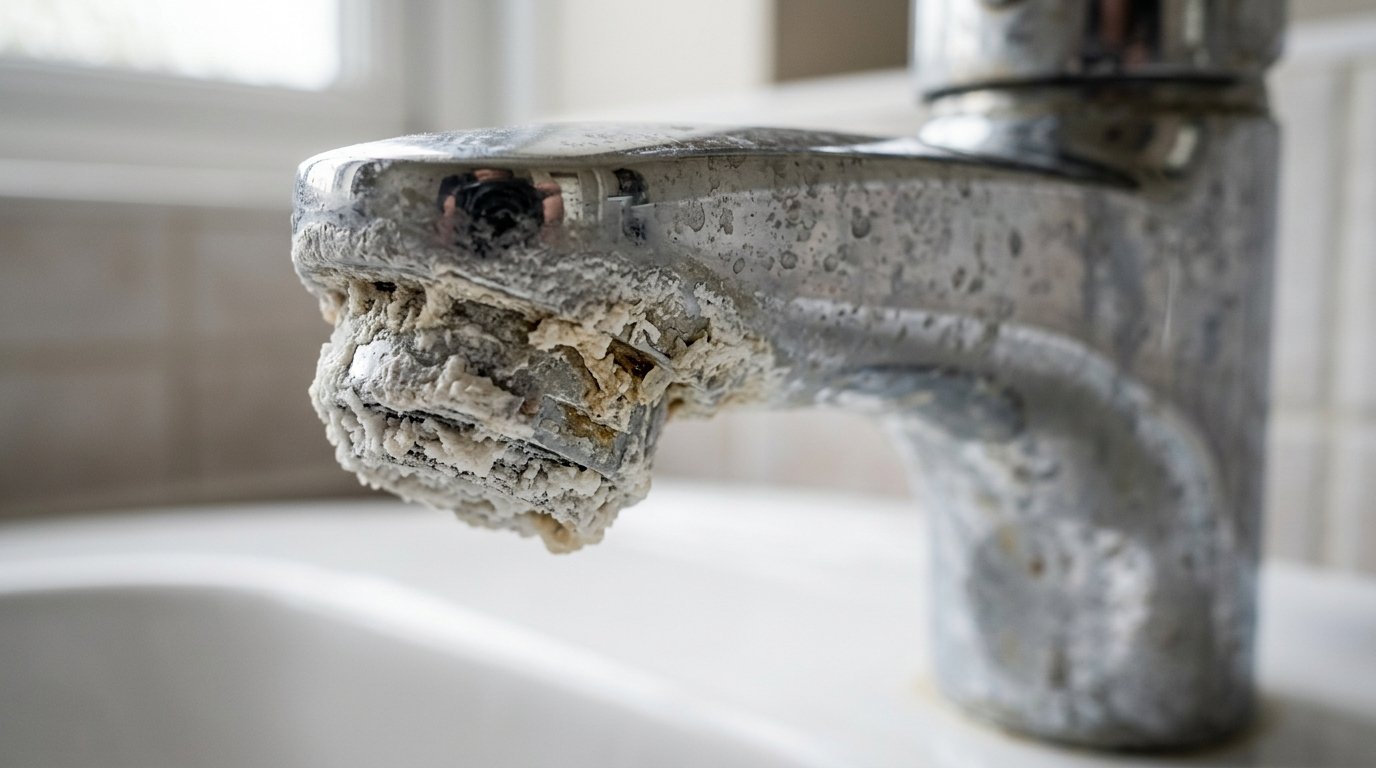
Short answer: Northern Utah’s water averages 15–25 grains per gallon — among the hardest in the United States. Over time, that mineral content scales the inside of supply pipes, drastically shortens water heater lifespan (often by 30–50%), clogs fixtures, and degrades dishwashers, washing machines, and ice makers. A whole-home water softener is the only effective protection.
If you’ve ever noticed a white crust around your faucets, cloudy spots on your glasses, or a filmy residue in the shower, that’s Northern Utah’s hard water leaving its mark. The Great Salt Lake basin produces some of the hardest municipal water in the entire country — and most homeowners in Weber, Davis, and Cache counties have no idea what it’s quietly doing to their plumbing every single day.
What Makes Northern Utah’s Water So Hard?
Water hardness is measured in grains per gallon (GPG). Anything above 7 GPG is considered hard. Most of Northern Utah sits between 15 and 25 GPG — the high end of what water utilities report anywhere in the United States. The reason comes down to geology. Water in the Great Salt Lake basin picks up calcium and magnesium as it moves through limestone and mineral-rich soil before it ever reaches your tap. Cities like Ogden, Roy, Layton, and Syracuse all pull from sources in this basin, and Cache Valley — with its distinct mountain runoff feeding into harder aquifer systems — isn’t much better. This isn’t a filtration failure. It’s simply where you live. The minerals are naturally occurring, and your pipes and appliances pay the service scope for it year after year.
The Visible Signs of Hard Water in Your Home
Hard water announces itself in ways that most people chalk up to poor cleaning habits rather than a water quality issue. The chalky white or yellowish buildup around faucets and showerheads is calcium carbonate — it forms wherever water evaporates and leaves minerals behind. On glass shower doors and dishware, it shows up as a hazy film that doesn’t rinse off cleanly no matter which factors soap you use. Your skin and hair may feel dry or dull after showering, because the same mineral content that coats your fixtures is interfering with soap’s ability to lather and rinse properly. These surface symptoms are annoying, but they’re minor compared to what’s happening inside your pipes where you can’t see it.
What Hard Water Is Doing Inside Your Pipes
Scale buildup doesn’t just happen on the outside of your fixtures — it accumulates on the interior walls of your supply pipes. Over years, this layer of mineral deposit narrows the internal diameter of the pipe, restricting water flow and increasing pressure on valves, joints, and connections. In older Ogden homes with galvanized steel or copper pipes, this buildup compounds existing corrosion issues. You might notice gradually dropping water pressure at the fixtures farthest from your main line — a bathroom at the end of a long run, or the upstairs shower. That reduction in flow is often the pipe slowly choking itself. Left unchecked, heavily scaled pipes become brittle and more prone to pinhole leaks and joint failures, particularly in homes with hard water that has been running untreated for decades.
How Hard Water Destroys Water Heaters
Your water heater is where hard water damage accelerates fastest. Cold water entering the tank carries dissolved calcium and magnesium, and when it heats up, those minerals precipitate out and settle as sediment on the bottom of the tank. Over time, that sediment layer insulates the heating element from the water it’s supposed to heat — your burner works harder, runs longer, and your energy bills climb. The popping and rumbling sounds you might hear from a tank-style water heater are sediment being heated and cracking — a sign the tank is already working in degraded condition. Hard water also accelerates the consumption of the anode rod, the sacrificial metal rod that protects the tank lining from corrosion. In soft-water areas, an anode rod might last 4-5 years. In Northern Utah, we often see them fully depleted in 2-3 years, leaving the tank liner exposed. We’ve seen water heaters in Weber County fail in as few as 5 or 6 years because they were never flushed and had no water softener upstream.
Appliances, Fixtures, and Long-Term impact
The same mineral buildup affects every appliance that touches your water supply. Dishwashers accumulate scale on spray arms and heating elements. Washing machines develop buildup on valves and hoses. Ice makers clog. Coffee makers need constant descaling. Nationally, hard water has been estimated to reduce appliance lifespan by 30-50% in severely affected areas, and Northern Utah qualifies as severely affected. Fixtures degrade too — showerheads lose flow as mineral deposits clog the small ports, and faucet aerators need replacing far more often than they would in a soft-water city. The cumulative impact across an entire household over 10-15 years can easily run into the thousands.
The Solution: Water Softening and Proactive Maintenance
A whole-home water softener is the most effective way to protect your plumbing from hard water damage. Softeners work through ion exchange — trading the calcium and magnesium ions in your water for sodium ions, producing water that won’t form scale. We install WaterTech systems, which are well-suited to Northern Utah’s hardness levels and sized appropriately for the mineral load your water carries. Beyond the softener, annual water heater flushes remove accumulated sediment before it compounds into a bigger problem, and anode rod inspections every 3-4 years in hard water homes are a simple maintenance step that can add years to a tank’s life. If you haven’t had your water tested or your water heater serviced in the last few years, it’s worth doing — especially in Weber and Davis counties where the water hardness tends to test on the higher end of the range.
Northern Utah’s hard water is a fact of life, but the damage it does to your plumbing doesn’t have to be. The homes we service across Ogden, Layton, Roy, and the surrounding area show us firsthand what years of untreated hard water look like inside pipes and water heaters — and it’s usually more expensive to ignore than to address. If you’re ready to protect your plumbing and appliances, give Mike Bachman Plumbing a call at (801) 627-5953. We’ve been solving Northern Utah’s water quality problems since 1915.
About Mike Bachman Plumbing
Mike Bachman Plumbing has served Northern Utah since 1915 — six generations of the Bachman family solving plumbing problems across Weber, Davis, and Cache counties. We are fully licensed and insured in Utah, and every technician we send to your home is background-checked and drug-tested. Our work is backed by a 100% satisfaction guarantee, and we answer emergency calls 24 hours a day, 365 days a year.
Call (801) 627-5953 or visit our shop at 549 W 24th St, Ogden, UT 84401.